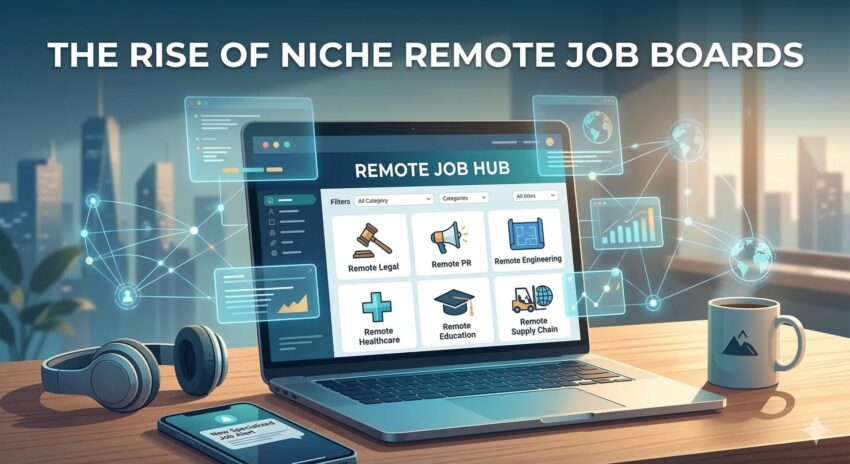
For years, the hunt for a remote career began and ended with giant aggregators like LinkedIn, Indeed, or the OG of the space, We Work Remotely. But as the “work from home” revolution matures, a new trend is emerging: the hyper-niche remote job board.
From platforms like FindRemoteLawJobs.com to RemotePRJobs.com, we are seeing a shift away from the “everything store” model toward curated boutiques. This isn’t just a fluke of the gig economy; it’s a fundamental shift in how specialized professionals find work.
Why Is This Trend Happening?
The move toward niche boards is driven by three main factors:
1. The “Signal-to-Noise” Problem General job boards are currently flooded. A single “Remote Project Manager” posting on LinkedIn can garner 1,000 applications in 24 hours—many of them from unqualified candidates or bots. Specialized boards act as a natural filter, ensuring that employers reach a pre-vetted pool of professionals who possess the specific certifications and industry language required.
2. Industry-Specific Nuances Remote work looks different in law than it does in public relations. A lawyer needs to know about bar reciprocity and state-specific licensing, while a PR professional might care about agency vs. in-house remote structures. Niche boards allow for custom search filters (like “Practice Area” or “Media Relations Specialty”) that general sites simply don’t offer.
3. The Professionalization of Remote Work Remote work is no longer just for data entry or software coding. Highly regulated, “white-collar” professions have realized that the physical office is optional. As these high-stakes industries move online, they demand a more professional, tailored environment for talent acquisition.
5 Industries Ripe for Their Own Remote Job Boards
While tech and marketing have dominated the remote space, several other industries are lagging behind and could probably use their own dedicated remote hub. Here are five sectors to think about:
1. Remote Civil Engineering & Architecture
While site visits are sometimes necessary, a massive portion of engineering and architectural work—CAD drafting, structural analysis, and blueprint reviews—is done digitally. A dedicated board for RemoteAEC (Architecture, Engineering, and Construction) jobs would allow firms to find licensed PEs (Professional Engineers) who can work across state lines on the design phase of projects.
2. Telemedicine Specialized Nursing
We have general healthcare boards, but a niche site specifically for Remote Nursing (RN/NP) would be a game-changer. This board could focus on triage tele-health, insurance case management, and remote patient monitoring (RPM). It would allow nurses to filter by license compact states (NLC), which is a major hurdle in the industry.
3. Remote Higher Education Administration
Universities are increasingly moving their student services online. There is a growing need for a board dedicated to Remote Higher Ed, focusing on online admissions counseling, academic advising, and financial aid processing. These roles require a specific understanding of FERPA regulations and university CRM systems that general boards ignore.
4. Remote Supply Chain & Logistics
The global supply chain is managed via software. Roles like Freight Broker, Demand Planner, and Logistics Coordinator are perfectly suited for remote work. A dedicated board would allow companies to find experts in specific ERP software (like SAP or Oracle) and global trade compliance without sifting through unrelated “warehouse” listings.
5. Remote Nonprofit & Grant Writing
Nonprofits often operate on lean budgets and can’t always afford the overhead of a physical office. A board dedicated to Remote Impact Careers would connect specialized grant writers, donor database managers (Blackbaud/Raiser’s Edge), and nonprofit strategists with missions they care about, regardless of geography.
The Bottom Line
The “generalist” era of the internet is fading. As remote work becomes the standard rather than the exception, professionals want to hang out where their peers are. Whether you are a litigator or a publicist, the future of your career likely isn’t on a massive job board—it’s on a curated platform that speaks your language.