A record-breaking influx of job seekers is driving massive top-of-funnel traffic across recruitment platforms, but the underlying dynamics behind the surge present both an operational challenge and a product pivot point for online job board operators.
Visits to the top 100 U.S. job boards rose 10% year-over-year in September 2026, reaching 661.2 million total visits—an increase of nearly 60 million visits compared to September 2025, according to new data from market intelligence platform Similarweb. August set an annual record at 685.1 million visits, and preliminary data for October tracks another 10.5% gain.
Industry leaders continue to capture the lion’s share of engagement:
- Indeed generated more than 166 million visits in September alone.
- ZipRecruiter and Greenhouse held firm as top traffic drivers directly behind Indeed.
- LinkedIn saw monthly visits increase more than 9% year-over-year, alongside a 30% rise in submissions per applicant relative to pre-pandemic baselines.
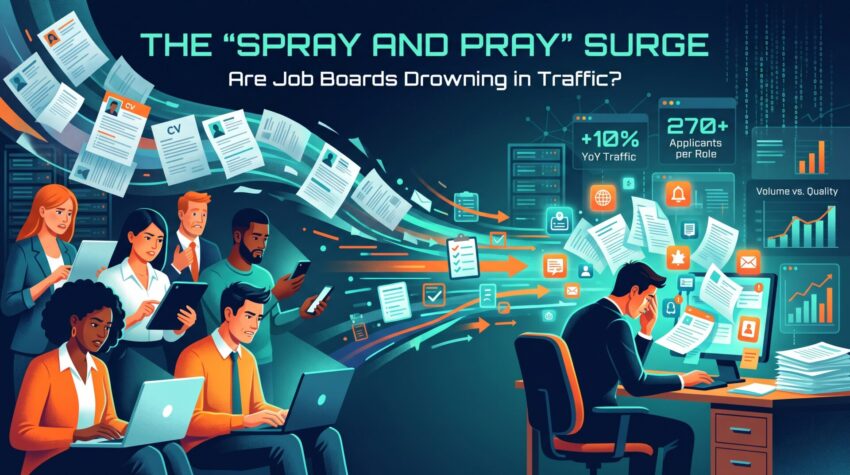
- Greenhouse reported that employers on its platform are fielding 20% more applications year-over-year, with open roles now attracting an average of 270 applicants per posting.
The Engine Behind the Volume: AI Automation Meets ‘Spray and Pray’
While the headline metrics suggest booming user acquisition, market analysts caution that the growth is not driven by expansion in hiring budgets or new job creation. Instead, traffic spikes reflect applicant anxiety and widespread automation across a sluggish labor market.
A May 2026 Gallup poll found just 28% of adults believe it is a good time to find a quality job (down sharply from 70% in 2022), while October Pew Research data shows 48% are deeply concerned about job availability—the highest rate recorded in five years.
Facing prolonged search cycles, job seekers have adopted an aggressive “spray-and-pray” strategy, amplified by consumer AI tools that auto-generate resumes and rapidly submit applications.
“Applying online is easy and familiar,” noted J.T. O’Donnell, founder and CEO of Work It Daily, explaining that desperation drives candidates to apply en masse to roles where they may have little relevant background.
This behavior is triggering an escalating loop across the ecosystem:
- Low response rates prompt candidates to leverage generative AI to submit dozens of applications daily.
- Employer ATS pipelines are inundated, forcing hiring managers to deploy aggressive automated screening tools to reject applicants in bulk.
- Ghosting and automated rejections spike, driving candidates straight back to job boards to submit even more applications.
What This Means for Platform Operators
For niche, industry-specific, and commercial job board operators, this shift alters the relationship between candidate traffic and employer retention.
- Traffic is decoupling from employer ROI: High visitor and click numbers no longer guarantee happy hiring managers. When corporate postings receive hundreds of irrelevant submissions, employers face hiring fatigue and may churn from cost-per-click (CPC) or standard subscription job boards.
- The imperative for pre-screening: With automated candidate blasts devaluing basic application delivery, boards that prioritize qualified candidate delivery over sheer lead quantity are better positioned to protect sponsor margins. Features such as verified credentialing, required screening assessments, and application caps are becoming competitive differentiators.
- Monetization models under pressure: Pure cost-per-application (CPA) models risk backlash if hiring teams discover that candidate matching quality has dropped due to bulk submissions. Value is shifting toward curation, direct talent matching, and outbound sourcing tools that shield recruiters from top-of-funnel noise.
While the current labor climate guarantees an active, high-intent pool of daily active users, job board owners must focus on helping employers sift through the volume to protect long-term recruitment spend. Niche boards should pound home the quality vs quantity messaging.